
Forest Carbon Uptake and Storage
Find out more about forested carbon pools, such as the size of different pools, duration of time carbon is within a specific pool, and the transfer of carbon between pools.
Forest Carbon Uptake and Storage Across Sites
Read about how carbon is influenced by forest characteristics such as stand age, tree species composition, structural diversity, soil properties, and climate, at a site-level scale.
The Global Carbon Budget
Forests help mitigate climate change by absorbing atmospheric carbon dioxide (CO2) and store carbon within soils and forest biomass (IPCC 2023). When managing forests for carbon benefits, it is important to understand the size of the current land sink (how much carbon is taken up and stored in terrestrial ecosystems) in comparison to carbon emissions from fossil fuel use and land use change.
The use of fossil fuels like coal, oil, and gas has added a large amount of carbon to the atmosphere since industrialization began in the mid-1800s, and this trend has accelerated in the last half century (Figure 1). Land use change, such as converting existing forests to development, has also added CO2 and other greenhouse gases to the atmosphere, amplifying the greenhouse gas effect (Figure 2) and contributing to climate change (Friedlingstein et al. 2025).
Atmospheric CO2 concentrations would be much higher today if not for the role of oceans and lands (Figure 1). Oceans and lands act as important sinks for CO2 and are currently mitigating, or offsetting, some of the emissions from fossil fuels and land use change by taking up and storing carbon (Friedlingstein et al. 2025).
Though land is currently acting as a sink, the potential to decrease its capacity as a carbon sink and increase atmospheric CO2 concentrations through land use change is large, but the potential to change the global carbon budget through forest management activities is smaller. In other words, efforts to avoid land use change are likely to have a greater impact on mitigating climate change than relying solely on forest management to offset emissions.
In forest ecosystems, management generally has the greatest influence on greenhouse gas mitigation via changes in CO2 uptake and emissions. It is important to note, however, that other greenhouse gases like methane and nitrous oxide also contribute to climate change and can be important in some ecosystems, such as wetlands.
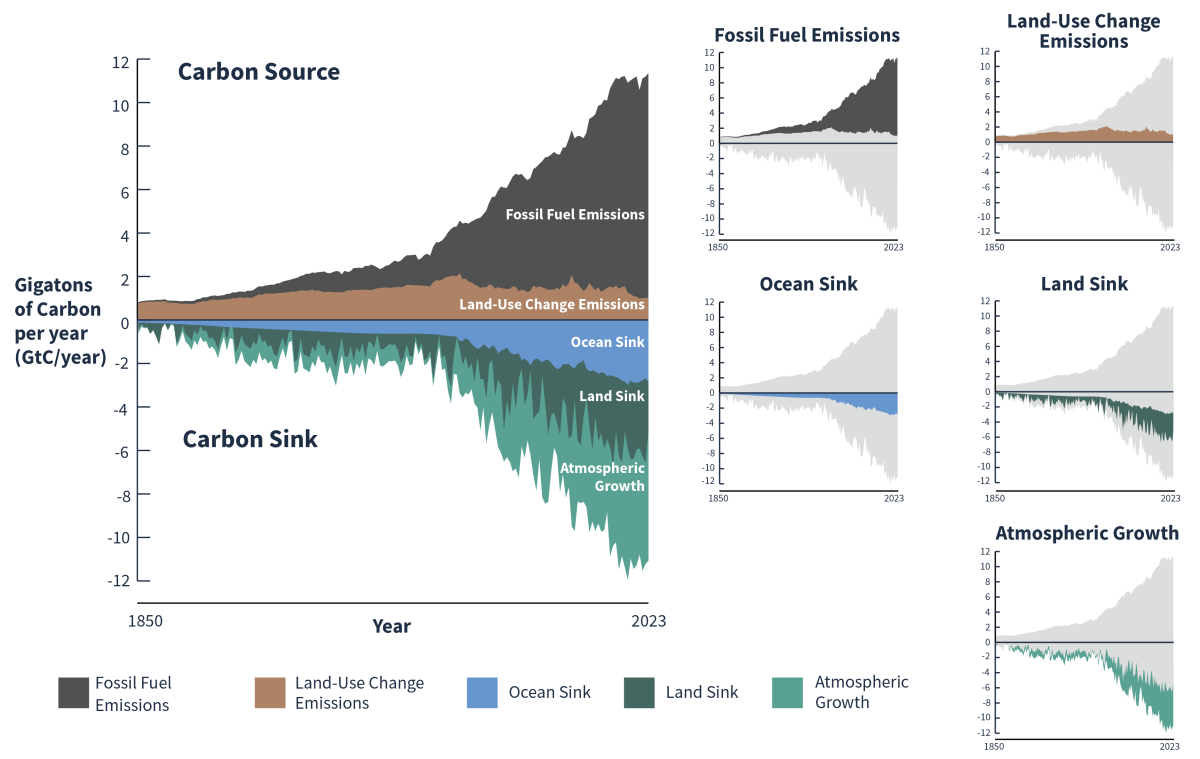
Figure 1.
The many factors that have contributed to the global carbon budget since 1850 are shown as annual estimates of carbon flux (Gigatons of carbon per year [GtC/year]). Emissions from fossil fuel use and land use change are an addition to the carbon budget (shown on the graph as positive values above the zero line). The ocean, land, and atmosphere are carbon sinks (shown on the graph as negative values below the zero line) and are cumulatively offsetting additions from emissions. Figure adapted from Friedlingstein et al. (2025).
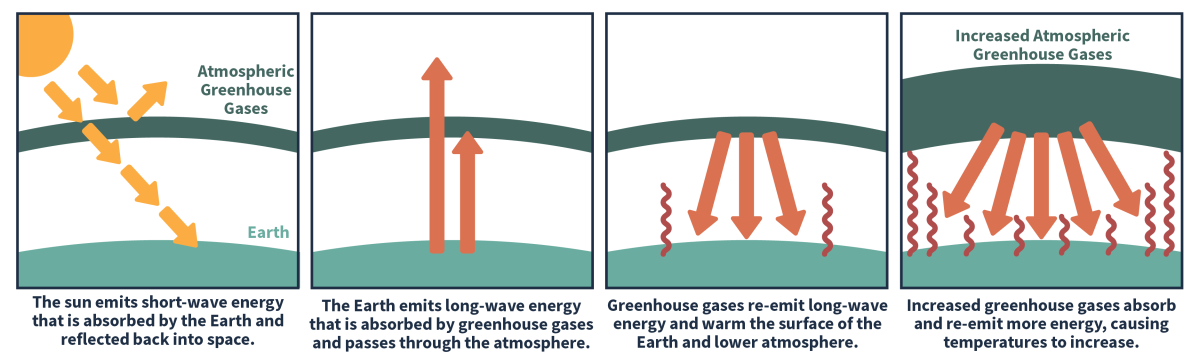
Figure 2.
These panels illustrate the greenhouse gas effect, a naturally occurring process that warms the Earth's surface. An increase in greenhouse gases causes an increase in the greenhouse gas effect.
Terrestrial Carbon in the U.S.
Globally, terrestrial ecosystems serve as substantial carbon sinks, storing much more carbon than they release. The amount of carbon stored in a particular system is called a pool. Within the boarder forest carbon pool, there are generally five carbon: live aboveground carbon (for example, trees and shrubs), live belowground carbon (roots), dead wood carbon, forest floor carbon (leaves, needles, and twigs), and soil carbon (Figure 3). Carbon pools are discussed in more depth in the Forest Carbon Uptake and Storage topic page. Most of the terrestrial carbon in the United States is stored within the soil carbon pool. Compared to other ecosystem types, forests hold the most carbon when biomass (live aboveground, live belowground, and dead wood) and soils are combined (Figure 4A). Forests also absorb the most CO2 annually relative to other ecosystems in the United States. However, the rate of carbon uptake by forests pales in comparison to CO2 emissions to the atmosphere from fossil fuels (Figure 4B). This reinforces the point that the influence of forest management on the carbon budget and its climate mitigation potential needs to be considered in the context of fossil fuel emissions.
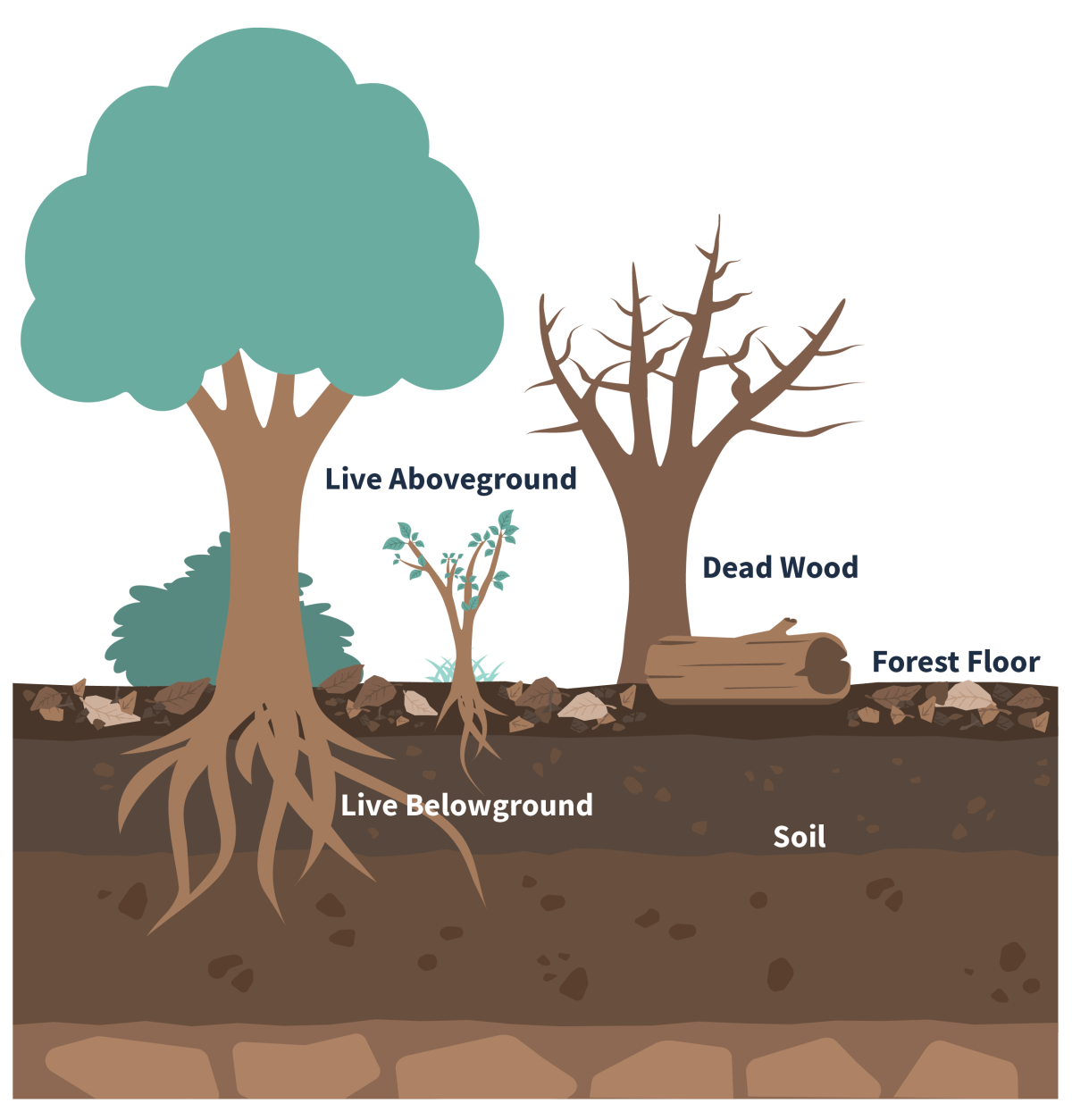
Figure 3.
Carbon stored in forested ecosystems is commonly divided into five main carbon pools: live aboveground, live belowground, dead wood, forest floor, and soil carbon.
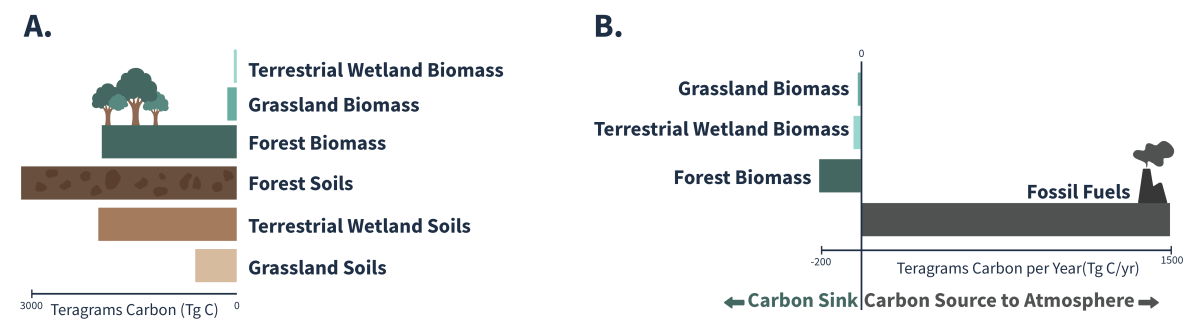
Figure 4.
Carbon storage (A) and carbon flux (B) vary between ecosystems and among pools within a given ecosystem. Annually, carbon flux from fossil fuel emissions into the atmosphere exceeds the uptake of carbon from biomass (B). Figures adapted from USGCRP 2018.
Carbon as Part of a Cycle
Carbon naturally cycles from the atmosphere to land and back to the atmosphere in what is called the biogenic carbon cycle (Figure 5). Disturbances such as wildfire and forest harvest can alter the timing at which carbon returns to the atmosphere. For example, a stand-replacing fire may emit a large pulse of carbon into the atmosphere quickly, but without such a disturbance this carbon would be gradually released to the atmosphere through decomposition. When biomass is harvested in a forest for wood products, the carbon in the biomass is removed from the site, but it is not released into the atmosphere instantly. Instead, carbon from harvested wood products is emitted into the atmosphere once those products decompose. Carbon from pulp or bioenergy products could be emitted to the atmosphere quickly post-harvest, but other harvested wood products such as an antique wood table would store carbon for a long time.
The use of fossil fuels disrupts the biogenic carbon cycle. Using fossil fuels moves carbon that has been kept out of the atmosphere for millions of years into the active carbon cycle and into the atmosphere. This release of fossil carbon into the atmosphere is the main driver of climate change, along with land use change. This contrasts with the smaller impacts that management and disturbance have on the rate of forest carbon cycling, such as when thinning occurs while maintaining the ecosystem as a forest.
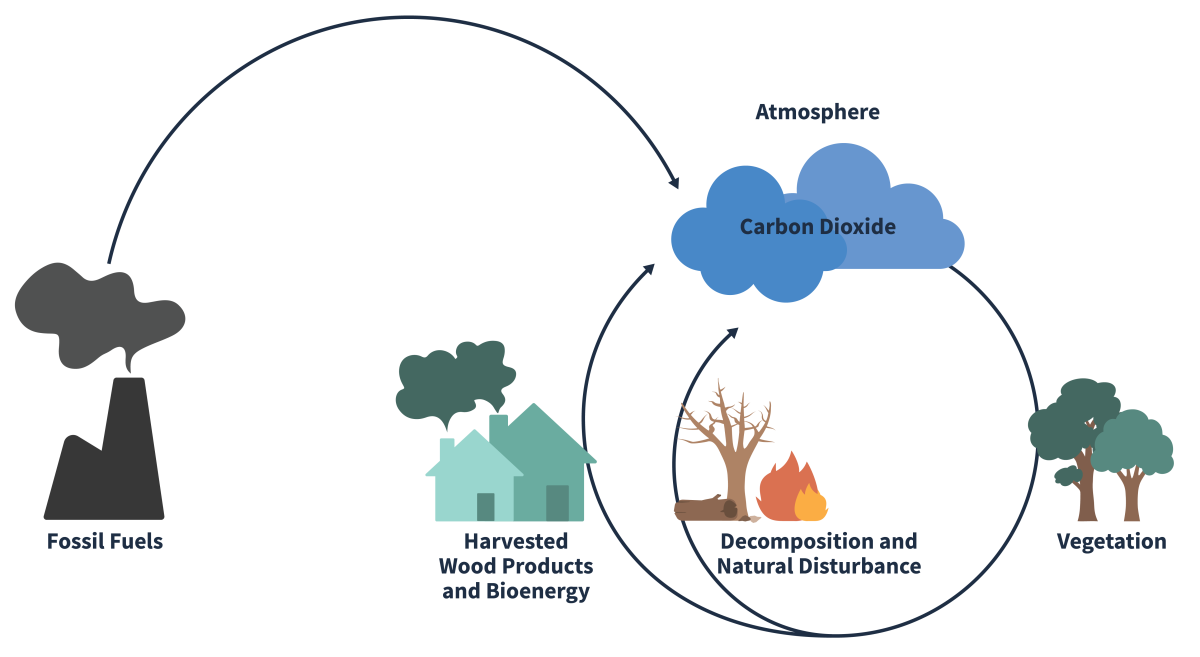
Figure 5.
Carbon cycles naturally between the land and atmosphere in the biogenic carbon cycle. Harvested wood products store carbon and that carbon then reenters the cycle when those products decompose. Fossil fuels add carbon to the atmosphere and disrupt the biogenic carbon cycle.
Key Terms
- Biogenic carbon
- Biomass
- Carbon cycle
- Carbon emissions
- Carbon flux
- Carbon pool
- Carbon sink
- Carbon storage
- Carbon uptake
- Disturbance
- Ecosystem
- Forest management
- Fossil carbon
- Global carbon budget
- Greenhouse gas effect
- Harvested wood products
- Land use change
For more terms and definitions, see the Carbon Terminology page.
About this Topic Page
This text was prepared by:
- Adrienne Keller, Northern Institute of Applied Climate Science, Michigan Technological University.
- Katie Frerker, Northern Institute of Applied Climate Science, USDA Forest Service Eastern Region.
- Manashree Padiyath, formerly Northern Institute of Applied Climate Science, USDA Forest Service Northern Research Station.
- Kailey Marcinkowski, Northern Institute of Applied Climate Science, Michigan Technological University.
Graphics were adapted, designed, and produced by Kailey Marcinkowski, Northern Institute of Applied Climate Science, Michigan Technological University.
This topic page is part of a collection of resources related to understanding forest carbon.
References
Friedlingstein, P.; O’Sullivan, M.; Jones, M.W. [et al.]. 2025. Global carbon budget 2024. Earth System Science Data. 17(3): 965–1039. https://doi.org/10.5194/essd-17-965-2025.
Intergovernmental Panel on Climate Change [IPCC]. 2023. Climate change 2023: synthesis report. Contribution of Working Groups I, II and III to the Sixth Assessment Report of the Intergovernmental Panel on Climate Change [Core Writing Team; Lee, H.; Romero, J., eds]. Geneva, Switzerland: Intergovernmental Panel on Climate Change. 35–115. https://www.ipcc.ch/report/ar6/syr/.
U.S. Global Change Research Program [USGCRP]. 2018. Second state of the carbon cycle report (SOCCR2): a sustained assessment report. [Cavallaro, N.; Shrestha, G.; Birdsey, R. [et al.], eds.]. Washington, DC: U.S. Global Change Research Program. 878 p.