
Forests and the Global Carbon Cycle
Learn about the global carbon budget, including how land sinks and fossil fuel emissions affect carbon dioxide levels, forested carbon pools in the United States, and how carbon cycles naturally through the land and atmosphere.
Forest Carbon Uptake and Storage Across Sites
Read about how carbon is influenced by forest characteristics such as stand age, tree species composition, structural diversity, soil properties, and climate, at a site-level scale.
Carbon Pools
Carbon is stored in five different pools, or reservoirs, within a forest ecosystem (Figure 1).
- Live aboveground carbon: This pool includes living plants like trees, shrubs, forbs, grasses, and sedges, although often only tree measurements are used to estimate carbon within forest ecosystems. This pool represents the primary entry point for atmospheric carbon into the ecosystem through photosynthesis.
- Live belowground carbon: This pool includes the belowground portion of all living plants, such as coarse and fine roots. Estimates of live belowground carbon are often made in proportion to aboveground plant biomass.
- Dead wood carbon: This pool includes standing dead trees or dead wood on the ground.
- Forest floor carbon: This pool includes forest floor litter, such as leaves and needles on the ground.
- Soil carbon: This pool includes organic and mineral soils, which in most forests, accounts for a substantial amount of carbon storage. While mycorrhizal fungi are truly part of the living belowground carbon pool, fungi (and other soil microbes) are usually measured as part of the soil carbon pool.
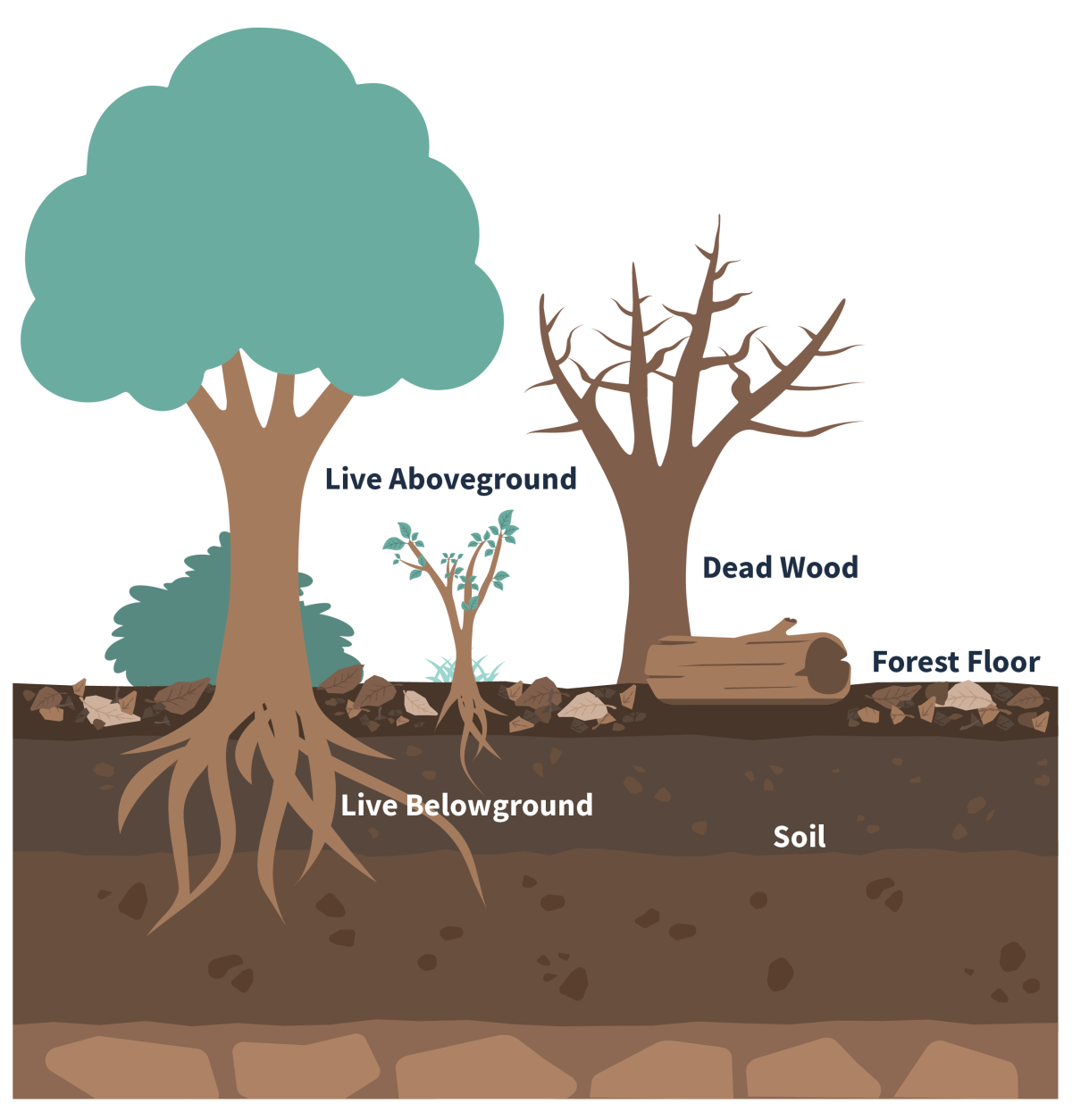
Figure 1.
Carbon stored in forest ecosystems is commonly divided into five main carbon pools: live aboveground, live belowground, dead wood, forest floor, and soil carbon.
Carbon Fluxes
Carbon moves among these different pools within ecosystems, as well as moving between these pools and the atmosphere. The transfer of carbon from one pool to another is called a flux. On average, carbon uptake by forests is greater that their CO2 emissions, which means forests serve as carbon sinks.
Pool Sizes and Mean Residence Time
Forest ecosystem carbon pools vary in size and across sites depending on the ecosystem type and site characteristics. In the example of an eastern hardwood forest, the soil carbon pool is the largest carbon pool and the live aboveground pool is the second largest pool (Figure 2). Within a site, these carbon pools are different sizes and also have different mean residence times, or the average amount of time that carbon resides in the pool before moving to another pool. For example, carbon in the forest floor has a short mean residence time as it tends to cycle quickly, moving either back to the atmosphere or to the soil carbon pool on the order of weeks to years. Live aboveground, belowground, and dead wood carbon pools cycle on timescales of years to decades. Soil carbon, which is one of the largest pools in most forests, has the longest retention time, ranging from decades to centuries. Factors such as site conditions and climate influence both the relative size of different carbon pools and their mean residence times.
Forest management often focuses on the live aboveground carbon pool because it is the carbon pool that is most easily measured and managed and cycles from years to decades at management-relevant timescales.
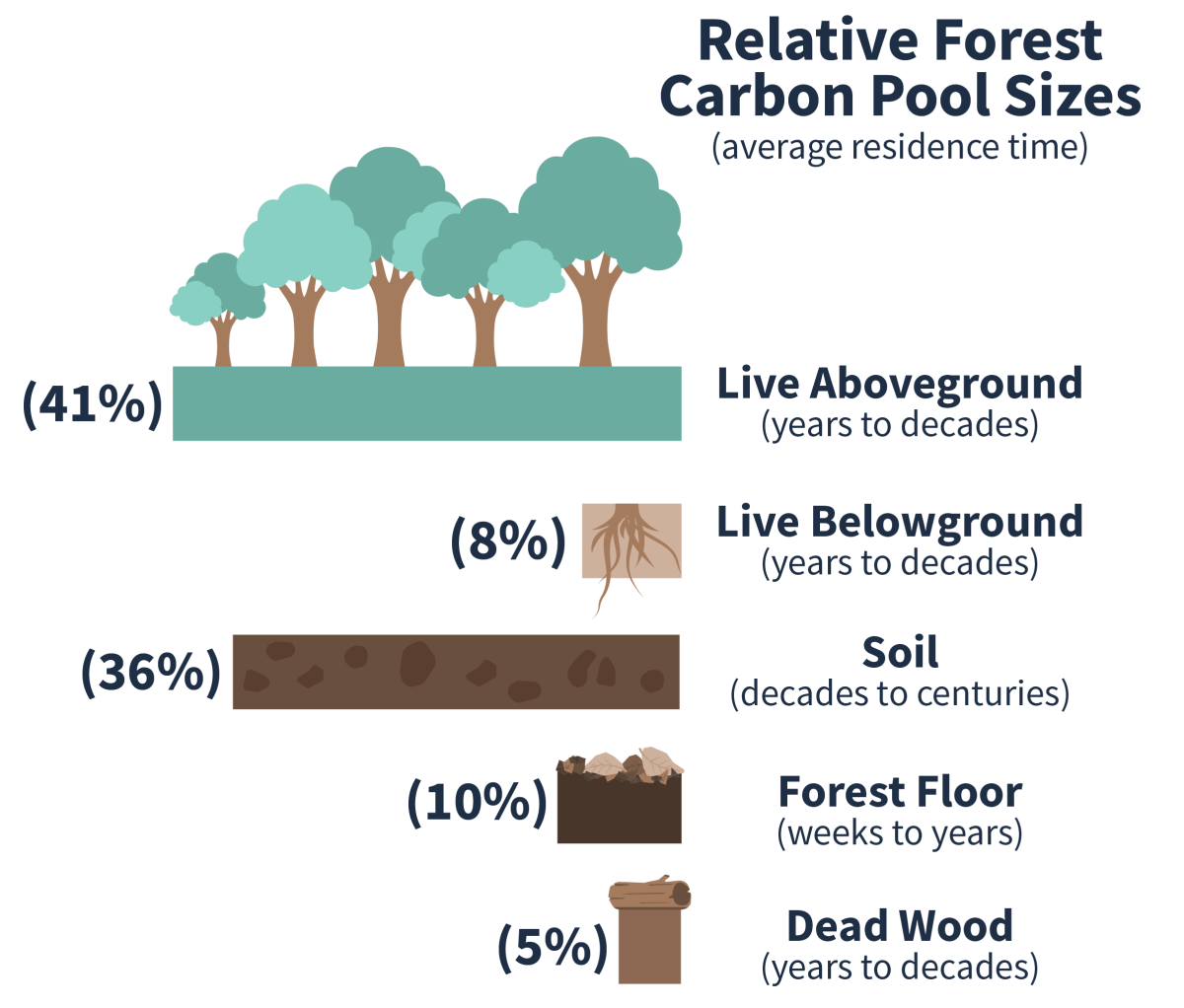
Figure 2.
These images compare forest carbon pool sizes and the average amount of time that carbon spends in each pool. Pool sizes are estimates based on regional data from Jackson et al. (1996), Liu et al. (2012), Woodall et al. (2013), and Domke et al. (2016). Exact pool sizes vary across sites. Figure from Keller and Handler (2024).
Key Terms
- Biomass
- Carbon cycle
- Carbon emissions
- Carbon flux
- Carbon pool
- Carbon sink
- Carbon storage
- Carbon uptake
- Ecosystem
- Forest management
- Mean residence time
- Photosynthesis
For more terms and definitions, see the Carbon Terminology page.
About this Topic Page
This text was prepared by:
- Adrienne Keller, Northern Institute of Applied Climate Science, Michigan Technological University.
- Katie Frerker, Northern Institute of Applied Climate Science, USDA Forest Service Eastern Region.
- Manashree Padiyath, formerly Northern Institute of Applied Climate Science, USDA Forest Service Northern Research Station.
- Kailey Marcinkowski, Northern Institute of Applied Climate Science, Michigan Technological University.
Graphics were adapted, designed, and produced by Kailey Marcinkowski, Northern Institute of Applied Climate Science, Michigan Technological University.
This topic page is part of a collection of resources related to understanding forest carbon.
References
Domke, G.M.; Perry, C.H.; Walters, B.F. [et al.]. 2016. Estimating litter carbon stocks on forest land in the United States. Science of The Total Environment. 557–558: 469–478. https://doi.org/10.1016/j.scitotenv.2016.03.090.
Jackson, R.B.; Canadell, J.; Ehleringer, J.R. [et al.]. 1996. A global analysis of root distributions for terrestrial biomes. Oecologia. 108: 389–411. https://doi.org/10.1007/BF00333714.
Keller, A.B.; Handler, S. 2024. Effects of fire on ecosystem carbon in the Upper Midwest and Northeast United States: a primer. Technology Transfer. Houghton, MI: U.S. Department of Agriculture, Northern Forests Climate Hub. 8 p. https://doi.org/10.32747/2024.8633530.ch.
Liu, S.; Liu, J.; Young, C.J. [et al.]. 2012. Baseline carbon storage, carbon sequestration, and greenhouse-gas fluxes in terrestrial ecosystems of the Western United States. In: Zhu, Z.; Reed, B.C., eds. Baseline and projected future carbon storage and greenhouse-gas fluxes in ecosystems of the western United States. Professional Paper 1797. Reston, VA: U.S. Department of the Interior, Geological Survey.
Woodall, C.W.; Walters, B.F.; Oswalt, S.N. [et al.]. 2013. Biomass of carbon attributes of downed woody materials in forests of the United States. Forest Ecology and Management. 305: 48–59. https://doi.org/10.1016/j.foreco.2013.05.030.