
Climate variability and change are threatening the health, diversity, and productivity of America’s forests. Forest assisted migration, the human-assisted movement of tree species in response to climate change, is one management option that is available to address this challenge.
Find more forest assisted migration resources
Trees are adapted to specific combinations of environmental and climatic conditions that allow them to grow, thrive, and reproduce. Climate change is already altering conditions across the planet, and changes are expected to continue in the decades to come. The rapid pace of climate change may exceed the ability of many species to adapt in place or migrate to suitable habitats. This fundamental mismatch raises the possibility of compromised forest health, local extirpation, or even extinction. Assisted migration, or human-assisted movement of species in response to climate change, is one management option that is available to address this challenge. This topic page will examine some of the scientific background and management considerations related to assisted migration, with a focus on forest assisted migration, which considers the movement of tree species in forested landscapes.
Scientific Background
 Evidence suggests that tree species have responded individually during historic periods of dramatic climate change through geographic migrations to and from unique glacial refugia [1, 2, 3]. Recent research has demonstrated that many tree species are already undergoing distribution shifts in response to climate change, with different studies highlighting species that are moving poleward and higher in elevation [4], or moving east-west to track changes in moisture availability [5].
Many factors can complicate species movement across a fragmented landscape, however, some outcomes of current climate change may not follow straightforward expectations. Large-scale Forest Inventory and Analysis (FIA) studies have revealed that many tree species in the eastern US may be experiencing range contraction at northern and southern range limits [6]. Research on Douglas-fir and ponderosa pine indicates that different genetic subspecies and local populations may have unique responses to climate change and different levels of vulnerability [7]. Ecosystem succession following the era of intensive logging and human land-use changes have both been suggested as explanations for tree species migrating downslope in New England mountains in recent decades [8]. Similarly, wildfire suppression practices may have also contributed to observed tree species movement in the eastern US, and species from different taxonomic groups are likely responding differently [5].
Despite the complexities of forecasting species range shifts into the future, the underlying challenge remains that the health, diversity, and productivity of tree species may be compromised to the point that they may face potential extinction or local extirpation if they do not acclimate, adapt via natural selection, or migrate to new suitable habitats as conditions change. Given the observed and projected rates of change, there is a substantial risk that some species will be unable to migrate quickly enough to track change [9]. Natural migration over long distances requires several generations, and this process is slow because trees require several years to reach reproduction age, and regeneration opportunities may be limited for a variety of reasons. Recent estimates indicate that post-glacial migration rates for many tree species were 100 to 500 meters per year [10, 11]. Recent rates of climate change for some locations in the US have been even more dramatic, with rates of change from 1,000 to 10,000 meters per year for large areas of the Midwest, Great Plains, and Southeast, as well as isolated locations in the western US [12]. These distances are a function of climate change rates and spatial climatic variation due to topography.
Efforts to increase ecosystem resilience through forest assisted migration may help buffer ecosystems against the wholesale loss of tree cover following disturbances. Ecosystem resilience can be enhanced by increasing the genetic diversity of the species that are planted and by increasing the species diversity of plants that are artificially regenerated [13]. Forest ecosystems with high levels of genetic and species diversity may be buffered against the plethora of pests and diseases that have become more commonplace as the climate changes [14,15].
Studies involving reciprocal transplants of different species along large gradients have demonstrated the potential for forest assisted migration to benefit tree species and local populations. For example, transplant studies of white spruce in Quebec showed that physiological traits such as photosynthetic rate and stomatal conductance were relatively plastic between populations and suggested that southern seed sources might be used in northern locations to increase growth and productivity without sacrificing seedling survival [16]. Promising results have been demonstrated for species with more restricted ranges as well. Trials with whitebark pine demonstrated that seeds can be successfully germinated and grown large distances (800 km, 500 miles) to the north of the current species range boundary – seed sources from Oregon and Washington performed well in locations in northwestern British Columbia [17]. These studies, and others, have demonstrated that forest assisted migration is a reasonable option to help populations and species occupy areas of projected suitable habitat under climate change.
Furthermore, forest assisted migration doesn’t necessarily need to be implemented as a widespread action to be successful. Even if small founder populations of individuals can survive beyond existing ranges, they may contribute genetic diversity associated with warmer climates to native populations such that the native populations might have a better chance to adapt through natural selection [18].
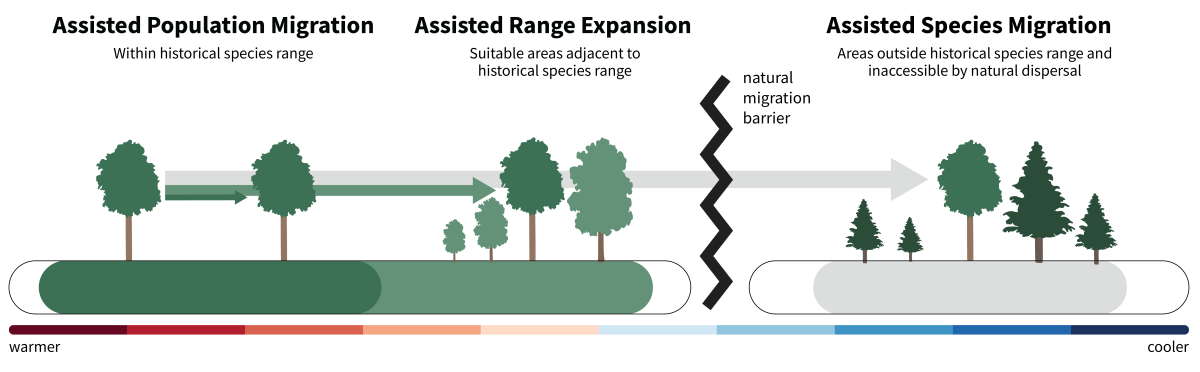
Definitions: Forest assisted migration, human-assisted movement of tree species in response to climate change, is a general term that encompasses a variety of different potential actions, which have substantial differences in terms of risk, ecological implications, and policy considerations. Here are some of the commonly used terms that distinguish between different forms of forest assisted migration [11]:
Assisted population migration (also assisted population expansion or assisted gene flow) – moving seed sources or populations to new locations within the historical species range
Assisted range expansion – moving seed sources or populations from their current range to suitable areas just beyond the historical species range, facilitating or mimicking natural dispersal
Assisted species migration (also species rescue, managed relocation, or assisted long- distance migration) – moving seed sources or populations to a location far outside the historical species range, beyond locations accessible by natural dispersal
Management Considerations
Forest assisted migration may be motivated by a variety of different management goals and objectives. Clarifying management intent is an important first step in considering how or if to pursue forest assisted migration, whether the goal is to maintain or enhance genetic diversity within a population, protect a species or population from extinction, mimic natural dispersal interrupted by human habitat barriers, maintain ecosystem functions, or enhance the productivity of a commercially valuable species. Clearly articulated management goals and objectives will help determine which kinds of assisted migration actions are most suitable (see above definitions) and help evaluate the benefits and risks.
Forest assisted migration raises legitimate concerns with respect to economic practicality, ecological suitability, and legal or administrative barriers [19]. In some cases, the concept of forest assisted migration will directly conflict with established conservation principles (e.g., the precautionary principle), Indigenous cultural values, or existing agency policy (e.g. designated seed transfer zones). In some cases, however, climate change and other conservation challenges may make the risk associated with doing nothing greater than the risk associated with intervening.
Briefly, some of the important management challenges and opportunities include:
Challenges:
- Newly introduced species may become invasive, particularly with long-distance transfers like assisted species migration.
- The potential exists for newly introduced species to hybridize with local species, particularly within certain genera with species pairs capable of interspecific hybridization, including spruce, pine, poplar, and oak. [10]
- Species introductions may unknowingly create unexpected interactions with pests or diseases in new areas, particularly with longer transfer distances.
- Long-distance transfers based on projected climate conditions at the end of the century raise the likelihood that current habitat may not be suitable for introduced genetic populations or species at the planting site, which could result in poor growth or planting failure.
- Species have different patterns of genetic diversity and plasticity, so some species will have smaller climatic transfer limits than others. For example, Douglas-fir and lodgepole pine may have smaller transfer limits than eastern white pine simply due to variation between species.
- Genetically diverse seed sources and sufficient quantities of seed may not currently exist for species with limited ranges or for species that are not commercially utilized.
- Forest assisted migration may be more costly to implement at scale than traditional regeneration practices, especially in situations where natural regeneration is commonly practiced. These costs will include cone and seed collection, orchard development, labor costs, and additional infrastructure.
- Site factors other than climate, such as soil type, moisture regime, herbivory, competition, endemic pests and pathogens, and photoperiod may preclude successful establishment. [20]
Opportunities:
- Forest assisted migration may help maintain forest productivity under climate change, particularly when suitable seed sources or populations are moved to locations within, or just beyond, the historical range.
- Assisted population migration and assisted range expansion may not add much cost to existing practices of forest regeneration for species that are routinely planted. [21]
- Provenance trial data are available for many widespread, commercially valuable tree species, which will help managers make informed decisions about the performance of seed sources from outside their local area.
- The genetic diversity of seed orchards can be controlled or increased to provide a suitable seed source for commercially valuable trees.
- Forest assisted migration may help maintain crucial ecosystem functions (wildlife habitat, carbon sequestration, etc.), particularly when local species are already declining or are anticipated to decline in the future.
- Forest assisted migration may help ensure that a species occurs in many redundant locations or across a range of conditions, which helps reduce risk from uncertain climate impacts.
- Forest assisted migration may help populations and species move across ecological barriers in fragmented landscapes.
- Assisted species migration (species rescue) may help “lifeboat” a species or population that is in critical risk.
About this Topic Page
This text was prepared by:
- Stephen Handler, Northern Institute of Applied Climate Science, USDA Forest Service Northern Research Station, Houghton, MI.
- Carolyn C. Pike, USDA Forest Service Eastern Region State, Private and Tribal Forestry, West Lafayette, IN.
- Katie Frerker, Northern Institute of Applied Climate Science, USDA Forest Service Eastern Region, Duluth, MN.
This topic page was originally published on the now discontinued USDA Forest Service Climate Change Resource Center website. The text has been updated with recent citations, information, and graphics (2025).
References
- Petit, R.J.; Hu, F.S.; Dick, C.W. 2008. Forests of the past: A window to future changes. Science. 320(5882): 1450-1452.
- Gonzales, L.M.; Williams, J.W.; Grimm, E.C. 2009. Expanded response-surfaces: a new method to reconstruct paleoclimates from fossil pollen assemblages that lack modern analogues. Quaternary Science Reviews. 28(27-28): 3315-3332.
- Davis, M.B.; Shaw, R.G. 2001. Range shifts and adaptive responses to Quaternary climate change. Science. 292(5517): 673-679.
- Chen, I.-C.; Hill, J.K.; Ohlemüller, R.; Roy, D.B.; Thomas, C.D. 2011. Rapid Range Shifts of Species Associated with High Levels of Climate Warming. Science. 333(6045): 1024-1026
- Fei, S.; Desprez, J.M.; Potter, K.M.; Jo, I.; Knott, J.A.; Oswalt, C.M. 2017. Divergence of species responses to climate change. Science Advances. 3(5).
- Zhu, K.; Woodall, C.W.; Clark, J.S. 2012. Failure to migrate: lack of tree range expansion in response to climate change. Global Change Biology. 18(3): 1042-1052.
- Rehfeldt, G.E.; Jaquish, B.C.; Sáenz-Romero, C.; Joyce, D.G.; Leites, L.P.; Bradley St Clair, J.; López-Upton, J. 2014. Comparative genetic responses to climate in the varieties of Pinus ponderosa and Pseudotsuga menziesii: Reforestation. Forest Ecology and Management. 324: 147-157.
- Foster, J.R.; D'Amato, A.W. 2015. Montane forest ecotones moved downslope in northeastern USA in spite of warming between 1984 and 2011. Global Change Biology. 21(12): 4497-4507.
- Groffman, P.; Kareiva, P.; Carter, S.; Grimm, N.; Lawler, J.; Mack, M.; Matzek, V.; Tallis, H. 2014. Ecosystems, Biodiversity, and Ecosystem Services. In: J. M. Melillo, T. T. C. Richmond and G. W. Yohe, eds. Climate Change Impacts in the United States: The Third National Climate Assessment. 8: U.S. Global Change Research Program: 195-219.
- Aitken, S.N.; Yeaman, S.; Holliday, J.A.; Wang, T.; Curtis-McLane, S. 2008. Adaptation, migration or extirpation: climate change outcomes for tree populations. Evolutionary Applications. 1(1): 95-111.
- Williams, M.I.; Dumroese, R.K. 2013. Preparing for climate change: Forestry and assisted migration. Journal of Forestry. 111(4): 287-297.
- Dobrowski, S.Z.; Abatzoglou, J.; Swanson, A.K.; Greenberg, J.A.; Mynsberge, A.R.; Holden, Z.A.; Schwartz, M.K. 2013. The climate velocity of the contiguous United States during the 20th century. Global Change Biology. 19(1): 241-251.
- Thompson, I.; Mackey, B.; McNulty, S.; Mosseler, A. Forest resilience, biodiversity, and climate change. In; 2009. 43. 1-67 p
- Millar, C.I.; Stephenson, N.L.; Stephens, S.L. 2007. Climate change and forests of the future: managing in the face of uncertainty. Ecological applications. 17(8): 2145-2151.
- Nagel, L.M.; Palik, B.J.; Battaglia, M.A. [and others]. 2017. Adaptive silviculture for climate change: a national experiment in manager-scientist partnerships to apply an adaptation framework. Journal of Forestry. 115(3): 167-178.
- Benomar, L.; Lamhamedi, M.S.; Rainville, A.; Beaulieu, J.; Bousquet, J.; Margolis, H.A. 2016. Genetic Adaptation vs. Ecophysiological Plasticity of Photosynthetic-Related Traits in Young Picea glauca Trees along a Regional Climatic Gradient. Frontiers in Plant Science. 7(48).
- McLane, S.C.; Aitken, S.N. 2012. Whitebark pine (Pinus albicaulis) assisted migration potential: testing establishment north of the species range. Ecological Applications. 22(1): 142- 153.
- Aitken, S.N.; Whitlock, M.C. 2013. Assisted Gene Flow to Facilitate Local Adaptation to Climate Change. Annual Review of Ecology, Evolution, and Systematics. 44(1): 367-388.
- Schwartz, M.W.; Hellmann, J.J.; McLachlan, J.M.; Sax, D.F.; Borevitz, J.O.; Brennan, J.; Camacho, A.E.; Ceballos, G.; Clark, J.R.; Doremus, H.; Early, R.; Etterson, J.R.; Fielder, D.; Gill, J.L.; Gonzalez, P.; Green, N.; Hannah, L.; Jamieson, D.W.; Javeline, D.; Minteer, B.A.; Odenbaugh, J.; Polasky, S.; Richardson, D.M.; Root, T.L.; Safford, H.D.; Sala, O.; Schneider, S.H.; Thompson, A.R.; Williams, J.W.; Vellend, M.; Vitt, P.; Zellmer, S. 2012. Managed Relocation: Integrating the Scientific, Regulatory, and Ethical Challenges. BioScience. 62(8): 732-743.
- Park, A.; Talbot, C.; 2018. Information Underload: Ecological Complexity, Incomplete Knowledge, and Data Deficits Create Challenges for the Assisted Migration of Forest Trees. BioScience. 68(4): 251–263.
- Pedlar, J.H.; McKenney, D.W.; Aubin, I.; Beardmore, T.; Beaulieu, J.; Iverson, L.; O'Neill, G.A.; Winder, R.S.; Ste-Marie, C. 2012. Placing Forestry in the Assisted Migration Debate. BioScience. 62(9): 835-842.