
Forests and the Global Carbon Cycle
Learn about the global carbon budget, including how land sinks and fossil fuel emissions affect carbon dioxide levels, forested carbon pools in the United States, and how carbon cycles naturally through the land and atmosphere.
Forest Carbon Uptake and Storage
Find out more about forested carbon pools, such as the size of different pools, duration of time carbon is within a specific pool, and the transfer of carbon between pools.
Disturbances in U.S. Forests
Disturbance in forests is a natural ecological process, although human actions can alter and have altered patterns of forest disturbance across the United States in recent decades. When management intentionally mimics natural disturbances, the ecological functioning and climate resilience of the forest can be enhanced.
The most common types of natural forest disturbance in the United States include fire, insects and disease, drought, heat, and wind. In addition to changing patterns of disturbance, many forests are experiencing heightened stress from climatic changes (USGCRP 2023). The changing climate is increasing the frequency and intensity of many disturbances and has become a “threat multiplier” for many ecosystems. When exposed to repeated disturbances, forests become more sensitive and less able to cope with and recover from disturbances over time. For example, forests that are experiencing drought stress can be more susceptible to some insect and disease outbreaks (Kolb et al. 2016).
Effects of Disturbance on Forest Carbon and Ecosystem Function
Disturbances can significantly impact forest carbon uptake and storage. The effect of a disturbance on forest carbon cycling depends on the type and extent of the disturbance, as well as local site characteristics such as tree species composition and diversity. In general, the more severe and extensive a disturbance is, the greater the loss in both carbon storage and future carbon uptake potential (Figure 1). Forests vary in how quickly carbon storage and uptake will return to pre-disturbance levels, with the effects from a changing climate also influencing the ability of forests to recover and regenerate (Dey et al. 2019). The biggest disturbance effects on carbon cycling happen when a forest converts to a different forest type or even to a different ecosystem type altogether, such as a forest converting to a shrubland.
Disturbances not only affect carbon cycling, but can also significantly impact other ecosystem properties such as nutrient cycling and biodiversity. The effects of disturbance on ecosystem functions can then feed back into the system to alter carbon uptake and storage. Managing forests for diverse ecosystem benefits can help mitigate the effects of disturbance and maintain forest carbon cycling (Ontl et al. 2020).
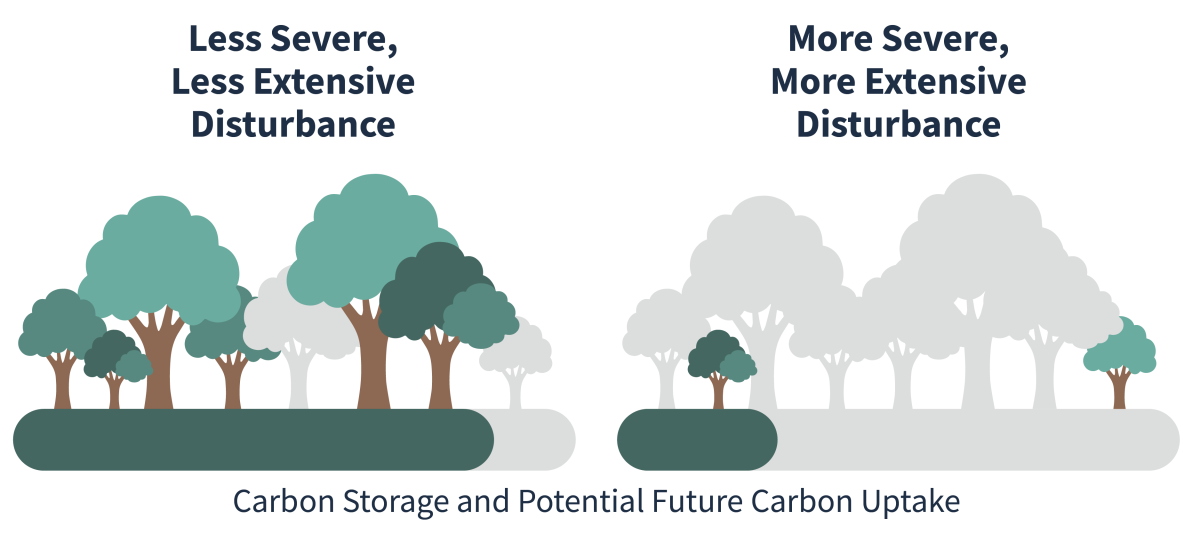
Figure 1.
The difference in carbon storage and potential future carbon uptake in a forest stand after a disturbance depends on the severity and extensiveness of the disturbance.
Types of Disturbance
Fire Disturbance
For many ecosystems, fire is a common disturbance that enhances local native plant biodiversity. Fire emits carbon into the atmosphere immediately during combustion and later when plant biomass affected by fire decomposes. The severity and extent of a fire influence its impact on carbon cycling. High-severity, stand-replacing fires generally lead to large losses of carbon from the ecosystem that are not quickly recovered. Low-severity fires that primarily burn the forest understory and litter layer generally result in lower immediate carbon emissions and faster carbon recovery. This type of fire, which includes most prescribed fires, also often increases long-term forest resiliency to future high-severity fire events.
Large fires are relatively rare in the Midwestern and Northeastern United States but have increased in recent decades in the West. The length of the fire season is expanding across all regions in the United States (USGCRP 2023). In the coming decades, the Upper Midwest and Northeast are projected to experience an increase in wildfire activity compared to historical observations and a higher frequency of wildfire than other regions (Dye et al. 2024). Increases in wildfire activity and frequency may increase forest carbon emissions over time.
Insects and Disease
In recent decades, nonnative insects and diseases have led to greater forest mortality in the Upper Midwest and Northeast than in other regions of the country (USDA FS 2023). Insects and disease reduce forest growth, which in turn reduces carbon uptake. Continued impacts from insects and diseases can eventually increase tree mortality and decrease carbon storage in a forest (Figure 2).
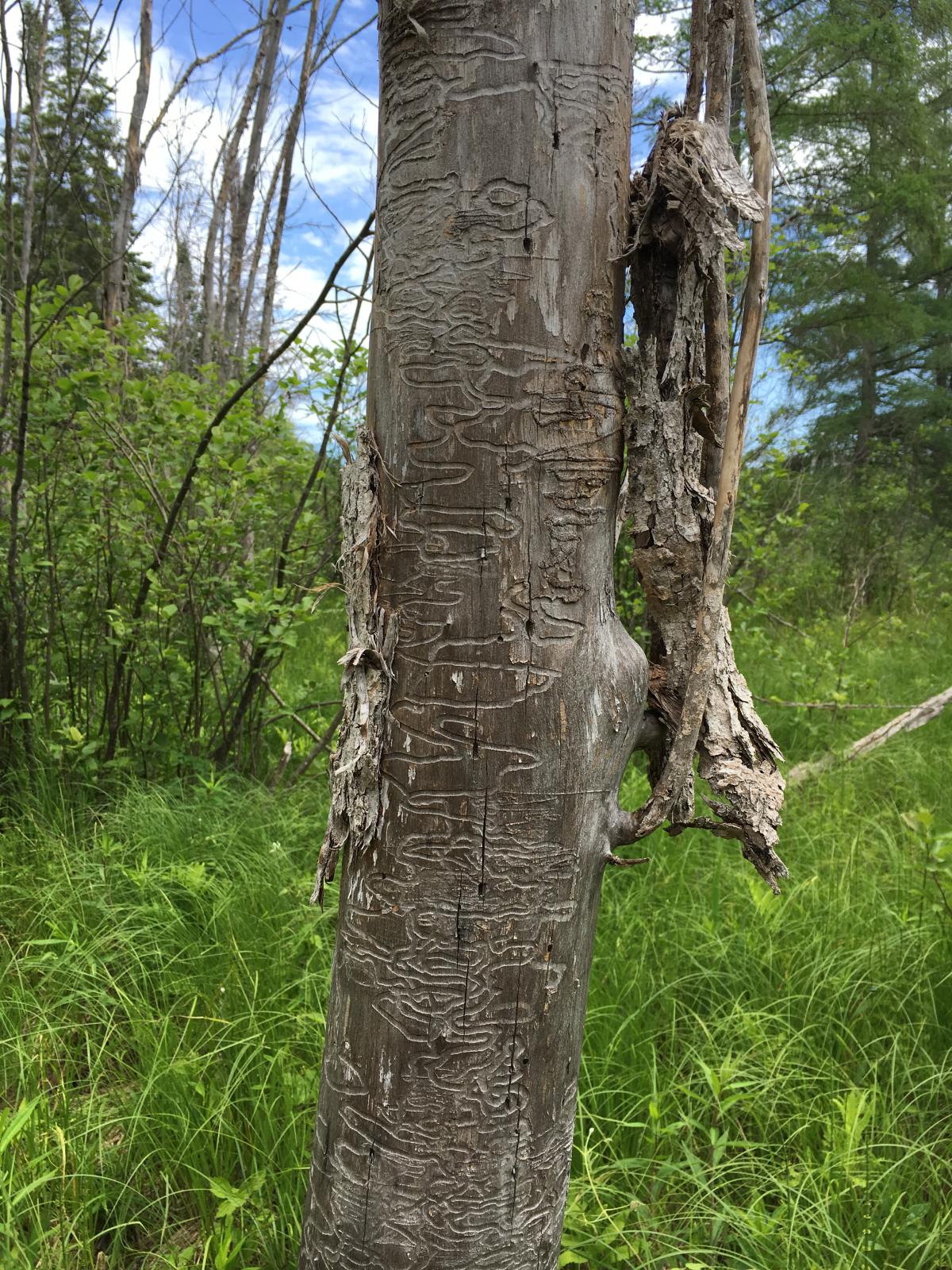
Figure 2.
This dead black ash tree shows evidence of Emerald Ash Borer; larval galleries indicate where larvae fed on the inner bark. USDA Forest Service photo by Nate Siegert.
Drought and Extreme Heat
Drought and extreme heat (“hot droughts”) can reduce photosynthesis, tree growth, and carbon uptake if trees are exposed to conditions beyond their tolerance zones. In the upper Midwest and Northeast, trees rarely die from drought alone, but from a combination of drought, extreme heat, and other disturbances such as insect outbreaks that can lead to significant mortality and reduced carbon storage (Coble et al. 2017).
Over the last century, many Midwest and Northeast forests have experienced mesophication, which is a shift in the composition of a forest to include more tree species that prefer wetter conditions. For example, many forests historically dominated by drought-tolerant oaks (Quercus spp.) have shifted to become dominated by maple (Acer spp.), which are less drought tolerant. How this observed change in tree species composition will affect the vulnerability of the region’s forests to drought is an active area of research. However, there is some evidence that maple-dominated forests are more stressed by late-season drought than oak-dominated forests, and late-season droughts can have strong “legacy effects” by suppressing subsequent years’ growth (Au et al. 2020).
Wind
Wind disturbances that uproot trees (blowdowns) can transfer aboveground forest biomass carbon to dead woody carbon pools that will then decompose and cause carbon losses. However, blowdowns can increase forest structural diversity, late-successional forest structure, and carbon storage if tree regeneration is successful (Meigs and Keeton 2018). Hurricanes, which are of higher intensity compared to blowdowns, more significantly reduce aboveground carbon storage and carbon uptake immediately following the disturbance. The overall effect of a hurricane on the carbon balance of a forest depends on whether the downed woody debris is left onsite or harvested. If left on site, the downed woody debris can continue to store carbon in the ecosystem for decades as it slowly decomposes. If the biomass is harvested, carbon may either be lost quickly to the atmosphere if the resulting wood products are short lived, like pulp, or remain out of the atmosphere for decades if stored in long-lived wood products (Tumber-Dávila et al. 2024).
Key Terms
- Biodiversity
- Biomass
- Blowdowns
- Carbon emissions
- Carbon pool
- Carbon storage
- Carbon uptake
- Disturbance
- Downed woody debris
- Ecosystem
- Forest management
- Forest stand
- Harvested wood products
- Litter layer
- Mesophication
For more terms and definitions, see the Carbon Terminology page.
About this Topic Page
This text was prepared by:
- Adrienne Keller, Northern Institute of Applied Climate Science, Michigan Technological University.
- Katie Frerker, Northern Institute of Applied Climate Science, USDA Forest Service Eastern Region.
- Manashree Padiyath, formerly Northern Institute of Applied Climate Science, USDA Forest Service Northern Research Station.
- Kailey Marcinkowski, Northern Institute of Applied Climate Science, Michigan Technological University.
Graphics were adapted, designed, and produced by Kailey Marcinkowski, Northern Institute of Applied Climate Science, Michigan Technological University.
This topic page is part of a collection of resources related to understanding forest carbon.
References
Au, T.F.; Maxwell, J.T.; Novick, K.A. [et al.]. 2020. Demographic shifts in eastern US forests increase the impact of late‐season drought on forest growth. Ecography. 43: 1475–1486. https://doi.org/10.1111/ecog.05055.
Coble, A.P.; Vadeboncoeur, M.A.; Berry, Z.C. [et al.]. 2017. Are Northeastern U.S. forests vulnerable to extreme drought? Ecological Processes. 6(1): 34. https://doi.org/10.1186/s13717-017-0100-x.
Dey, D.C.; Knapp, B.O.; Battaglia, M.A. [et al.]. 2019. Barriers to natural regeneration in temperate forests across the USA. New Forests. 50: 11–40. https://doi.org/10.1007/s11056-018-09694-6.
Dye, A.W.; Houtman, R.M.; Gao, P. [et al.]. 2024. Carbon, climate, and natural disturbance: a review of mechanisms, challenges, and tools for understanding forest carbon stability in an uncertain future. Carbon Balance and Management. 19: 35. https://doi.org/10.1186/s13021-024-00282-0.
Keller, A.B.; Handler, S. 2024. Effects of fire on ecosystem carbon in the Midwest and Eastern United States. Technology Transfer. Houghton, MI: U.S. Department of Agriculture, Northern Forests Climate Hub. 8 p. http://doi.org/10.32747/2024.8633530.ch.
Kolb, T.E.; Fettig, C.J.; Ayres, M.P. [et al.]. 2016. Observed and anticipated impacts of drought on forest insects and diseases in the United States. Forest Ecology and Management. 380: 321–334. https://doi.org/10.1016/j.foreco.2016.04.051.
Meigs, G.W.; Keeton, W.S. 2018. Intermediate‐severity wind disturbance in mature temperate forests: legacy structure, carbon storage, and stand dynamics. Ecological Applications. 28: 798–815. https://doi.org/10.1002/eap.1691.
Ontl, T.A.; Swanston, C.W.; Janowiak, M.K.; Daley, J. 2020. Practitioner’s menu of adaptation strategies and approaches for forest carbon management. In: Forest management for carbon sequestration and climate adaptation [Ontl, T.A; Janowiak, M.K.; Swanston, C.W.; Daley, J.; Handler, S.D.; Cornett, M.; Hagenbuch, S.; Handrick, C.; McCarthy, L.; Patch, N.]. Journal of Forestry. 118(1): 86-101. https://doi.org/10.1093/jofore/fvz062.
Tumber‐Dávila, S.J.; Lucey, T.; Boose, E.R. [et al.].. 2024. Hurricanes pose a substantial risk to New England forest carbon stocks. Global Change Biology. 30: e17259. https://doi.org/10.1111/gcb.17259.
U.S. Department of Agriculture, Forest Service [USDA FS]. 2023. Future of America’s forest and rangelands: Forest Service 2020 Resources Planning Act Assessment. Gen. Tech. Rep. WO-102. Washington, DC. 348 p. https://doi.org/10.2737/WO-GTR-102.
U.S. Global Change Research Program [USGCRP]. 2023. Fifth National Climate Assessment. [Crimmins, A.R.; Avery, C.W.; Easterling, D.R. [et al.], eds.]. Washington, DC: U.S. Global Change Research Program. https://toolkit.climate.gov/NCA5.