
Project Area

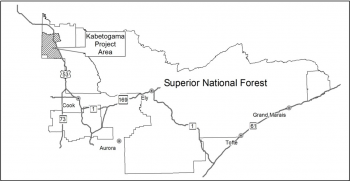 The Kab Project Area is located in St. Louis County in northeastern Minnesota, covering approximately 68,000 acres. National Forest System land covers about 22,000 acres within this landscape. The project area is approximately seven miles north of Orr, Minnesota and nine miles south of Kabetogama Lake. This area includes two primary Landscape Ecosystems – Mesic Birch/Aspen/Spruce-fir and Dry-Mesic Red and White Pine. The uplands within the project area are dominated by aspen, with a variety of other northern forest types.
Management Goals

The LaCroix Ranger District of the Superior National Forest is proposing the Kabetogama (Kab) Project to promote diverse, productive, healthy, and resilient native forest communities; improve forest health and productivity; provide sustainable forest products; improve riparian function; improve moose habitat for browse; and improve the Forest transportation system. Generally, aspen and mature/old forests exist in abundance, while there are zero acres in the young age class. Specifically, some of the major vegetation management goals of this project are to:
- increase the proportion of the forest in the 0-9 year age class,
- increase the acreage of jack pine, and
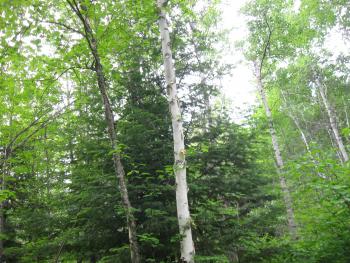
- increase within-stand species diversity (paper birch, white cedar, white spruce, white pine, red pine, and tamarack) and structural diversity.
Climate Change Impacts
Adaptation Actions
After considering the menu of adaptation strategies and approaches from the Adaptation Workbook, the Kabetogama project team generated several possible adaptation actions. The team considered incremental adjustments that could put the forest in a better position to adapt or tolerate continued climate change. They determined that many activities identified to move the forest towards the desired condition outlined in the Forest Plan would also be beneficial as climate change adaptation tactics. These “win-win” opportunities were preserved. Some example adaptation actions for the Kab project include: