
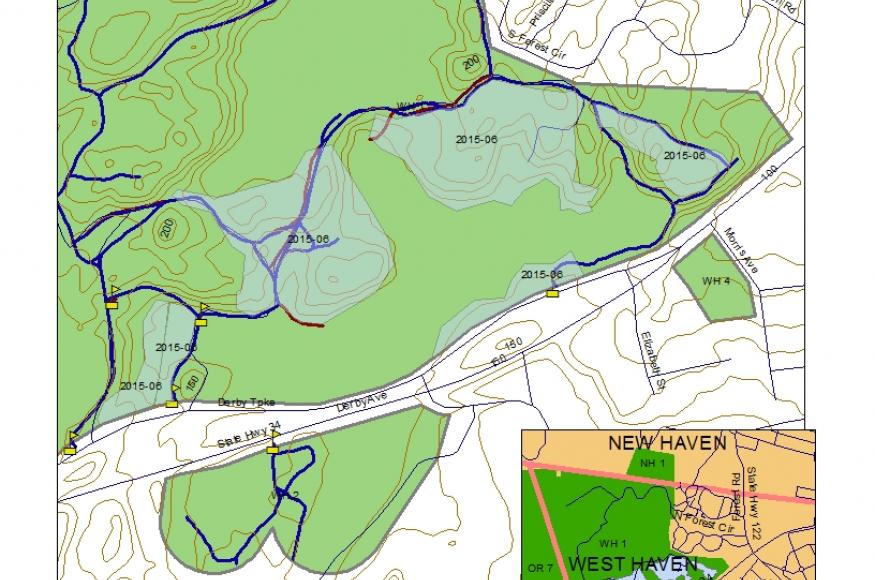


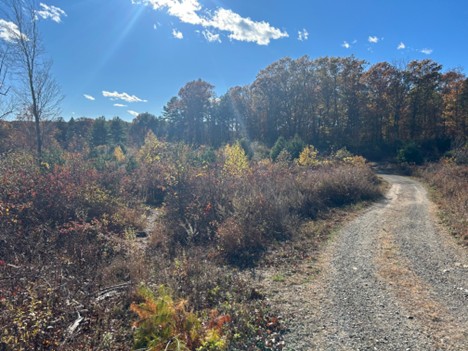
Project Area

 The South Central Connecticut Regional Water Authority owns and manages more than 27,000 acres of watershed land as part of its efforts to ensure a reliable supply of high-quality water to consumers. This adaptation demonstration focuses on a 24-acre area near the Maltby Lake Recreation Area that was damaged by southern pine beetle and recent blowdowns. Until recently, this area was dominated by large Norway spruce and white pine trees that were planted as early as 1902, but a recent infestation of the southern pine beetle is resulting in management to change forest conditions.
Management Goals
The Water Authority uses forest management as a way to protect water quality throughout the watershed. This entails diverse goals to protect forest integrity and key benefits and include protecting wetlands and water courses, conserving endangered species and special habitats, and providing recreational opportunities for residents and visitors.
This particular stand is already undergoing changes that are related to climate change. This stand was infested by the southern pine beetle, a bark beetle that is native to the southeastern U.S. and has been moving northward in response to warmer conditions. The beetle was first found in Connecticut in 2015, and it is raising concerns because populations that are allowed to grow unchecked can lead to large-scale outbreaks that can kill both stressed and healthy trees. As a result, this forest was clearcut during the summer of 2016 to reduce the threat of southern pine beetle on nearby forests.
Challenges and Opportunities
Challenges
Opportunities
Adaptation Actions
The salvage harvest that was performed in 2016 provides an opportunity to alter the forest in ways that will make it better able to withstand a variety of stressors, including forest pest and climate change.
The Adaptation Workbook was used to develop several adaptation actions for this project, including:
9.3. Guide changes in species composition at early stages of stand development.
9.7. Introduce species that are expected to be adapted to future conditions.