
Project Area

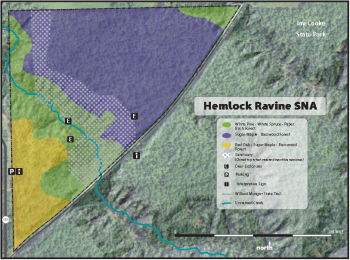 Hemlock Ravine State Natural Area is located directly adjacent to Jay Cooke State Park and the Munger Trail in Carlton County, Minnesota. Hemlock Ravine contains old-growth northern hardwoods, white pine, and eastern hemlock forest. This 51-acre site is at the extreme western range of eastern hemlock, a species which is considered very rare in Minnesota. More than 25 percent of the state's hemlock trees occur on this site, which is centered on a steep ravine along a small spring-fed stream. These highly erodible slopes are subject to wash-outs and disturbance by visitors that may endanger the hemlocks. For this reason, the ravine is designated a sanctuary.
Management Goals

Scientific and Natural Areas are designed to preserve Minnesota's natural heritage for present and future generations. SNAs have been designated to protect native plant and animal communities, rare species, biodiversity hotspots, and special geological features. Management goals are usually passive, designed to protect the sites from invasive species and pests, restore degraded conditions, and control visitor use. The management goals for Hemlock Ravine SNA include:
- maintaining old forest characteristics and ecological functions for the three distinct Native Plan Communities (MHn35b, Mhn44b, and MHn47a)
- maintaining eastern hemlock on the site
- removing and preventing establishment of terrestrial invasive species
Climate Change Impacts
When DNR staff considered climate change impacts that could be most important for this property, a few things stood out as priorities:
Warmer and drier conditions could be challenging for eastern hemlock. This SNA is the western edge of hemlock's range.
Milder winters could lead to more herbivory from deer and hares, which could harm white pine, hemlock, and other target species.
Large rain events could cause more erosion within the ravine on this property.
Challenges and Opportunities
Climate change will present challenges and opportunities for natural resources management at Hemlock Ravine SNA, including:
Challenges
Boreal species such as paper birch may be more vulnerable to climate change
Warmer temperatures may allow new invasive species to thrive in the area
Opportunities
Disturbances could cause canopy gaps, which would help create structural diversity and coarse woody debris
Some species present on site, like red oak and white pine, are expected to do well under climate change
Adaptation Actions
DNR staff used the Adaptation Workbook to develop several adaptation actions for this property, including:
Area/Topic
Approach
Tactics
Ravine area
1.1 Reduce impacts to soils and nutrient cycling.
4.1. Prioritize and maintain unique sites.
4.2. Prioritize and maintain sensitive or at-risk species or communities.
4.1. Prioritize and maintain unique sites.
4.2. Prioritize and maintain sensitive or at-risk species or communities.
The ravine area is protected as a sanctuary and access is discouraged.
2.3. Manage herbivory to promote regeneration of desired species.
9.4. Protect future-adapted seedlings and saplings.
9.4. Protect future-adapted seedlings and saplings.
Deer exclosures have been installed at a few locations within the ravine to protect hemlock regeneration and understory species
This experienced severe erosion after the large rain event in 2012, and more complete erosion control measures are necessary in the ravine.
Entire property
Monitor and remove invasive species
10.1 Promptly revegetate sites after disturbance.
10.2. Allow for areas of natural regeneration to test for future-adapted species.
10.2. Allow for areas of natural regeneration to test for future-adapted species.
Develop a regeneration plan to prepare for future wind events and large rainstorms.
Monitoring
Monitoring and research are some of the primary activities that occur at Scientific and Natural Areas. Project participants identified several monitoring items that could help inform future management at the Hemlock Ravine SNA, including:
Hemlock regeneration, including survival, growth, and expansion to new locations
Old forest characteristics, including snags, coarse woody debris, and species diversity
Presence of invasive species and the effectiveness of control techniques
Effectiveness and condition of deer closures
Keywords
Invasive species
Lowland/ wetland conifers
Upland hardwoods
Refugia