


Project Area

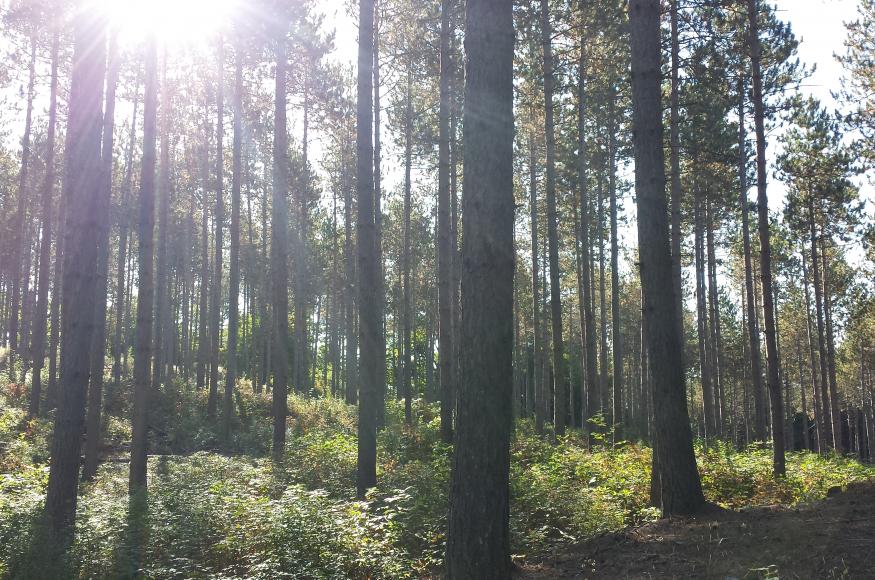
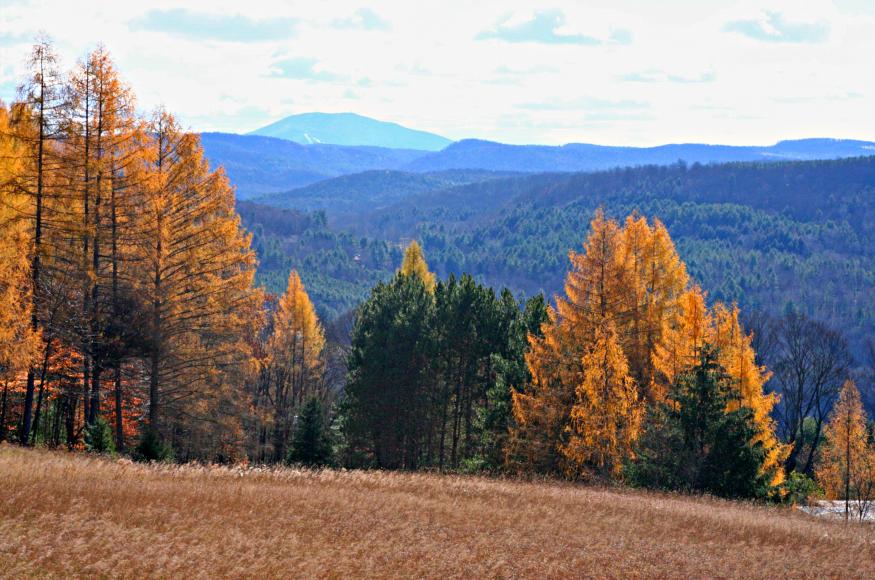
 Marsh-Billings-Rockefeller National Historical Park is a 550-acre park located east of Vermont's Green Mountains. The Park contains the Mount Tom Forest, which is the earliest surviving example of planned and managed reforestation in the country. It is a living exhibit that illustrates the evolution of forest stewardship in America, from the earliest scientific silvicultural practices borrowed from nineteenth-century Europe to contemporary practices of sustainable forest management. Nine of the plantations set out by Frederick Billings in the late 1800s still stand. Older trees, such as open-grown sugar maples and 400+ year-old hemlocks can still be found throughout the property.
Management Goals
Forest management on the Park strives to:
- Maintain a sense of the Forest’s history through broad landscape patterns and representative historic features while working with ecological processes and continuing to apply best current thinking and practices in forest management.
- Perpetuate the tradition of sustainable forest management on the property
- Incorporate a long-term perspective on the changing composition and character of the Forest
- Value the Forest as both a natural and cultural resource
- Emphasize the relationship of the Park’s forest management to broader community well-being and sustainability
- Strengthen civic engagement and stewardship
Climate Change Impacts
Adaptation Actions
Following the collection of scientific information about climate change and the Park, a meeting was held in May 2014 to consider how scientific information from the assessment could be integrated into Park activities in order to develop actionable steps to adapt forests at the Park to changing conditions and monitor outcomes. Participants represented the Park, the NPS Climate Change Response Program, the NPS Northeast Temperate Network I&M program, the NPS Northeast Region Office, Redstart Consulting, the Northern Institute of Applied Climate Science, the US Forest Service, and the Vermont Agency of Natural Resources. The Adaptation Workbook was used to identify potential adaptation actions for this project, which are listed below.
More recently, the Park has been continuing to build upon the ideas that were generated from the use of the Adaptation Workbook. The Park worked in collaboration with the University of Vermont’s Rubenstein School of Environment and Natural Resources and the Northern Institute of Applied Climate Science to develop a report on adaptive forest management that integrates climate change. This expands on the earlier work by developing and integrating adaptive management strategies and tactics into long-term planning. It also brings together a set of monitoring guidelines that can be used to evaluate the effectiveness of management actions. Notably, the report uses forest landscape simulation modeling to explore the potential long-term impacts of multiple adaptive forest management approaches and climate change scenarios on future forest conditions.
Information from all of these efforts are being use to inform forest management activities at the Park, including forest harvests and invasive species control.
5.2. Maintain and restore diversity of native species.
9.2. Establish or encourage new mixes of native species.
9.1. Favor or restore native species that are expected to be adapted to future conditions.
9.4. Protect future-adapted seedlings and saplings.