
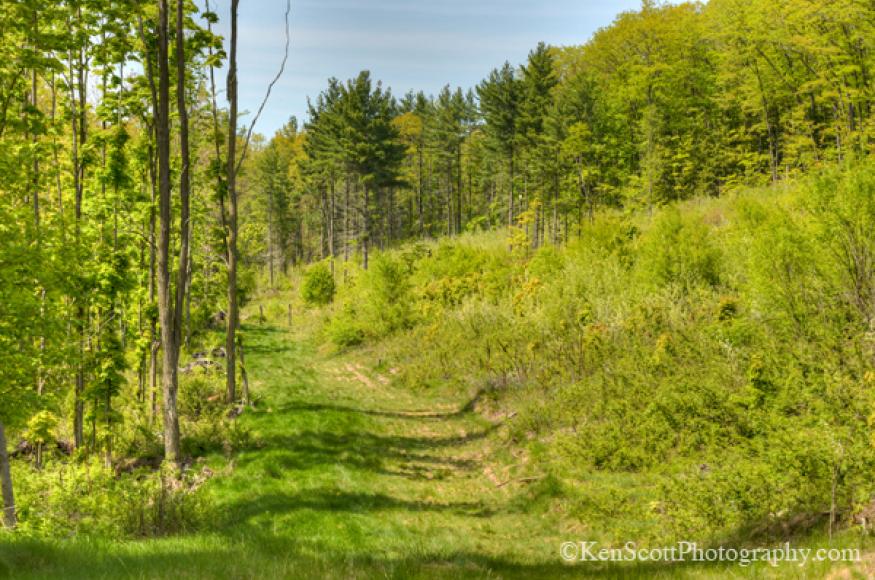

Project Area
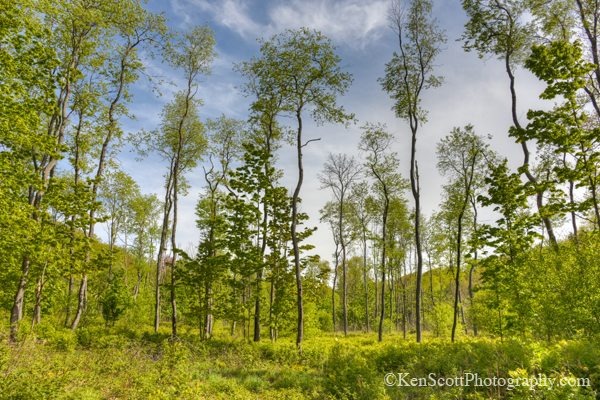
 The Krumwiede Forest Reserve is one of the signature forest reserves managed by the Leelanau Conservancy. The 110-acre property is managed as a working forest under a conservation easement established in 1997. A special feature of the property is its proximity to Sleeping Bear Dunes National Lakeshore - less than a mile separates this property from the National Lakeshore.
Management Goals
The Conservancy has several goals for the property, including maintaining forested habitats for native plants and animals; managing for a diverse, all-aged forest; producing wood products; and protecting water quality and functioning of wetlands, riparian areas, and vernal ponds.
Climate Change Impacts
Leelanau Conservancy Staff used the Adaptation Workbook from Forest Adaptation Resources to evaluate the potential climate change impacts for the Krumwiede Forest Reserve in particular. Potential climate change impacts that are of major interest to the management goals of this property include:
Altered hydrology from shifting precipitation patterns, more intense rainfall events, and longer growing seasons will impact soil moisture, leading to drier conditions in the late summer.
Invasive species may have increasing opportunities to establish in forests, due to longer growing seasons, warmer temperatures, and shifting disturbance regimes.
Habitat suitability will likely improve for some southern, temperate tree species such as black locust, black cherry, and oak species. Other species are likely to decline, such as ash, beech, and hemlock.
Proximity to Lake Michigan may moderate some of the projected temperature increases.
Adaptation Actions
Conservancy staff were able to identify several adaptation actions using the Adaptation Workbook that could be added to the proposed plan for the Krumwiede Forest Preserve. Examples include:
Area/Topic
Approach
Tactics
Entire property
Follow BMPs during forest harvest operations to prevent soil erosion on steep slopes.
Aspen stand
Convert aspen stand to a dry-mesic community that may be better adapted to future conditions. Underplant and favor species including black cherry, white pine, bitternut hickory, red oak, and white oak.
Black locust
Allow existing black locust clone to mature to harvestable size, underplant with black walnut and black cherry.
Surrounding landscape
Develop habitat corridors by identifying and protecting additional forest land between this property and Sleeping Bear Dunes National Lakeshore.
Keywords
Invasive species
Planting
Upland hardwoods