
Project Area

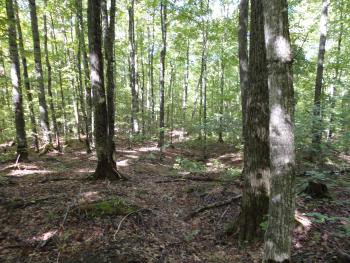 The project area is a 234-acre tract of Fee land located on the L’Anse Reservation in Baraga County, Michigan. This stand has a southern aspect, so it generally receives more solar radiation and exhibits warmer and drier conditions. Sugar maple is currently the dominant species in the overstory and in the seedling layer. Potential partners at this time include the U.S. Forest Service, Michigan Technological University, and State nurseries.
Management Goals
Expected outcomes for this project include:
- Establish sugar maple seedlings from various plant hardiness zones in the Upper Peninsula of Michigan.
- Determine if variants are capable of competing with local sugar maple.
- Determine if variants can outperform local sugar maple on a warmer and drier site.
- Enhance genetic diversity of the local sugar maple population.
Climate Change Impacts
Increased temperatures and altered precipitation regimes will likely have negative effects on local sugar maple populations.
Suitable habitat for sugar maple is predicted to decrease in the Keweenaw Peninsula as climate change accelerates.
It isn't likely that all sugar maple will be extirpated from the KBIC reservation, as refugia (areas where the landscape-level climate will be moderated by topographical features such as cold air drainages and northern aspect slopes) will still be present
Maple sugaring is an important activity for the KBIC, which may be threatened in the future.
Adaptation Actions
KBIC staff focused on a selection of adaptation actions from the Forest Adaptation Menu and Adaptation Workbook for this project idea:
Area/Topic
Approach
Tactics
Sugar maple stand
This project is designed to maintain a culturally important sugar bush stand for the community.
Conduct a group selection harvest in this stand to create canopy gaps to promote advance regeneration of sugar maple as well as mid-tolerant species.
Collect sugar maple seeds from across the geographic range of the species (Maine, Appalachian Mtns, Illinois, etc.) and grow them in a tree nursery for planting in the gaps from the group selection harvest.
Learn More
Keywords
Agriculture/ Agroforestry
Upland hardwoods