
Project Area
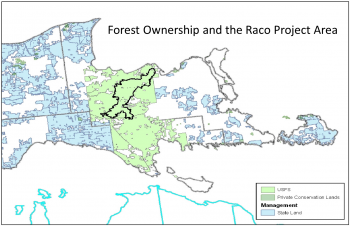 The Sault Ste. Marie and St. Ignace Ranger Districts of the Hiawatha National Forest are proposing a vegetation management project on the Raco Plains, located within Chippewa and Mackinac Counties, Michigan. The Raco sand outwash plain is a dynamic, fire-adapted ecosystem that was historically shaped by wildfire. Fire was instrumental in removing mature and dying jack pine, while preparing the site and releasing seeds for a new generation of jack pine. Regenerating jack pine provided habitat for the federally listed endangered Kirtland’s warbler (KW). Wildfire was historically responsible for maintaining open barrens and savannas used by species like sharp-tailed grouse and black-backed woodpecker.
Management Goals

Climate Change Impacts
The Raco Interdisciplinary Team considered broad climate change trends that are expected for Michigan forests and the site conditions across the project area. They identified several risks associated with climate change, as well as several opportunities. Some of these include:
Aspen and jack pine are projected to decline across northern Michigan under a range of climate scenarios. Jack pine might be less vulnerable because it is adapted to harsh environments and other species are unlikely to outcompete it on sandy outwash plain
Conditions that promote large wildfires may occur more frequently in the project area, and the wildfire season may shift beyond normal timeframes. This is a particular risk in such a fire-prone landscape.
Kirtland’s warbler habitat in the Upper Peninsula might become particularly valuable in the future, as habitat in the Lower Peninsula is likely to be more stressed by climate change.
Streams and rivers in the project area may be a risk of increasing water temperatures and altered flow regimes.
Adaptation Actions
After considering the menu of adaptation strategies and approaches from the Adaptation Workbook, the Raco project team generated several possible adaptation actions, ranging from conservative to more aggressive and proactive. Some example adaptation actions include:
Area/Topic
Approach
Tactics
Regeneration
4.2. Prioritize and maintain sensitive or at-risk species or communities.
5.1. Promote diverse age classes.
5.1. Promote diverse age classes.
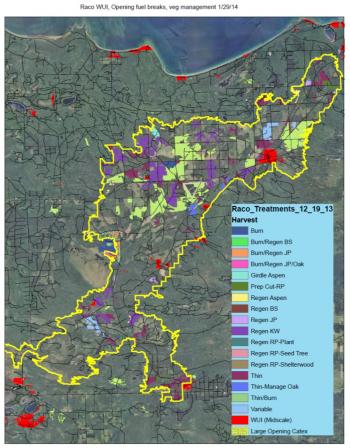
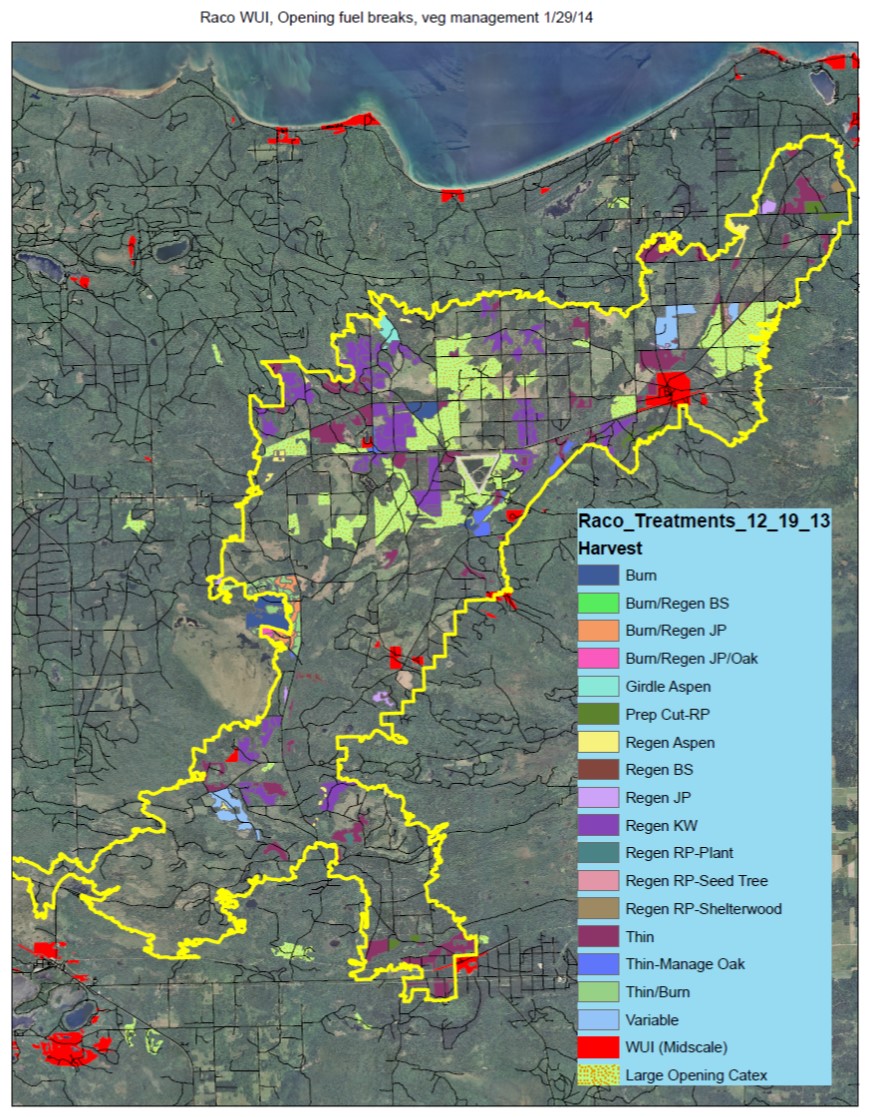
Regenerate 3,900 acres of jack pine, mostly in higher densities to provide habitat for Kirtland's Warbler
Fire
Maintain 5,460 acres of wildlife openings, both for wildlife habitat and strategic fuel breaks
Reclassify 819 acres to unsuitable for timber production, mostly sparse oak savannas
Establish 1,400 acres of shaded fuel breaks in WUI areas
Bottomlands/Riparian Areas
270 acres of riparian treatments, including planting white pine and long lived conifers, and releasing existing conifers by removing shrubs and hardwood overstory
Replace four stream crossing structures to improve aquatic organism passage and prepare for extreme precipitation events
Thinning
Commercial and pre-commercial thinning in 3,700 acres of red pine and jack pine stands
Learn More
Keywords
Fire and fuels
Water resources