
Project Area

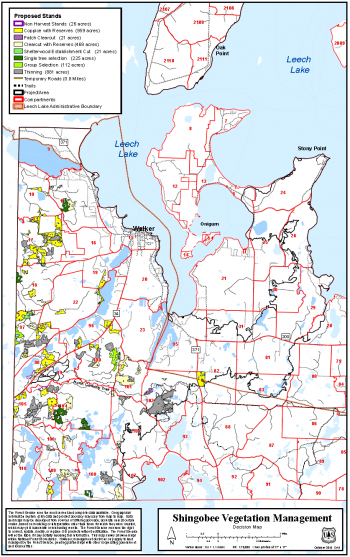 The project area is in the west-southwest area of the Chippewa National Forest and boarders Leech Lake and Highway 371 in the vicinity of Walker, Minnesota. The project area encompasses approximately 47,300 acres. The Forest Service ownership is about 24,000 acres. About half of the project area is within the boundary of the Leech Lake Band of Ojibwe Reservation. This project area includes a diversity of Landscape Ecosystems, but all management activities are planned to occur on only the Dry Mesic Pine-Oak and Dry Pine LEs. Fire was historically the common natural disturbance factor in these ecosystems.
Management Goals

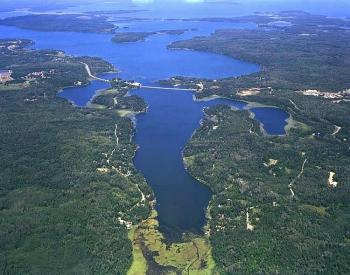
Some of the primary management goals for the Shingobee Project are to:
- move the forest toward stated goals for tree species composition and age class distribution, as outlined in the Forest Plan
- restore conditions more representative of native vegetation communities
- maintain and improve wildlife habitat
Specifically, some of the management objectives of the Shingobee Project are to:
- reduce the abundance of aspen
- increase acres of conifers like red pine, white pine, and jack pine
- increase the abundance of young forest
- increase or maintain large, mature upland forest patches
- manage hunter walking trails for grouse habitat
- promot long-lived tree species in streambanks and riparian areas
Climate Change Impacts
For this project, project participants felt the most important anticipated climate change impacts will include:
Areas of steep slopes along rivers and throughout the landscape may be prone to erosion with heavy precipitation events.
Roughly two-thirds of the project area includes south or west-facing slopes, which might be higher risk areas for drought stress. 40% of the project area occurs on sandy soils that might also be more drought-prone.
This area is the furthest south and west on the Forest - within 50 miles of the prairie-forest border. This area may experience vegetation shifts before other areas of the forest.
Challenges and Opportunities
Climate change will present challenges and opportunities for accomplishing the management objectives of this project, including:
Challenges
Deer population increases will make it more challenging to do diversity planting and favor oaks or white pine.
Extreme precipitation events could flood plantings in riparian areas and black ash swamps.
Opportunities
Oak species and white pine are projected to do well under climate change.
Adding species and structural diversity to stands gives them more options in the future.
Adaptation Actions
The project planning team used the Adaptation Workbook to develop several adaptation actions for the Shingobee project, many of which appeared in the final EA for the project:
Area/Topic
Approach
Tactics
Forest type conversions
Convert aspen to white pine on 14 acres, convert red pine to white pine on 17 acres, and convert mixed hardwoods to oak on 39 acres
Riparian areas
Planting and seeding long-lived conifers such as red pine, white pine, and white spruce
Use uneven-aged harvests and mechanical/hand scarification in riparian areas to promote diverse age classes of long-lived species.
Aspen stands
Clearcut with reserves and coppice cuts on nearly 900 acres will generate a young age cohort.
Red pine stands
2.1. Maintain or improve the ability of forests to resist pests and pathogens.
5.2. Maintain and restore diversity of native species.
5.2. Maintain and restore diversity of native species.
Commercial thinning on 946 acres will reduce stocking in red pine stands.
Retaining a diversity of tree species during thinning will promote diversity in red pine stands.
Oak stands
Clearcuts with reserves on nearly 500 acres will regenerate a young age class of oak.
Monitoring
Project participants identified several monitoring items that could help inform future management, including:
Project Documents
Shingobee EA.pdf
(832.75 KB)
Learn More
Keywords
Oak
Upland conifers