
Project Area

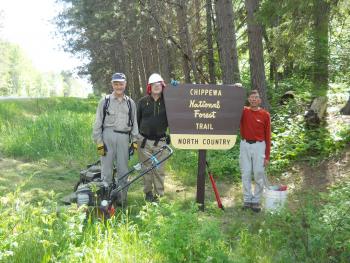 The Long Lake project area is located in the Deer River Ranger District of the Chippewa National Forest. It covers roughly 47,000 acres south of US Highway 2, along the south-east border of the National Forest. The Mississippi River runs through the project area and several lakes and wetlands are also mixed in with upland hardwoods and conifer stands. The Chippewa National Forest uses a system of Landscape Ecosystems to categorize the forest, and the Long Lake project area contains mostly Boreal Hardwood/Conifer and Dry-Mesic Pine Landscape Ecosystems. The North Country Trail also runs through this project area.
Management Goals

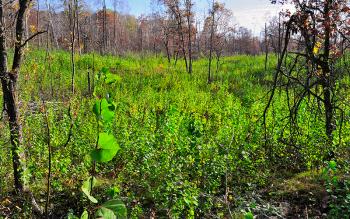
The Long Lake Vegetation Management Project is relatively complex, covering several forest types and resource areas. Some of the over-arching goals for this project include:
- move the forest ecosystems toward the Forest Plan goals for composition and age class (increasing white spruce, white pine, and oak, while reducing aspen)
- diversify black ash stands
- improve habitat for game species by emphasizing oak management, enhancing habitat in and around deer wintering areas, and increasing areas of mature spruce/fir and pine
Climate Change Impacts
For this project, the project planning team identified many important anticipated climate change impacts, including:
Areas of flat topography and large river floodplains in this project area may be prone to flooding with more heavy precipitation events
Earlier snowmelt and wetter springs could combine to extend the "spring breakup" period when roads are closed
There are several large deer yards in the project area. Milder winters could boost deer populations and alter where deer migrate during the winter.
Adaptation Actions
Project participants used the Adaptation Workbook to develop several adaptation actions for this project, including many that were already built into the Proposed Action:
Area/Topic
Approach
Tactics
Pine stands
5.2. Maintain and restore diversity of native species.
9.1. Favor or restore native species that are expected to be adapted to future conditions.
9.1. Favor or restore native species that are expected to be adapted to future conditions.
Increase in-stand diversity in pine stands, and reserve and promote oak during any harvest.
Thinning is planned for 1,100 acres of red pine, 75 acres of white pine, and 25 acres of white spruce.
Aspen stands
Clearcuts on roughly 1200 acres will maintain a young age cohort of aspen across the landscape.
9.1. Favor or restore native species that are expected to be adapted to future conditions.
9.5. Disfavor species that are distinctly maladapted.
9.5. Disfavor species that are distinctly maladapted.
Convert aspen to oak on 83 acres, mixed hardwoods on 63 acres, paper birch on 24 acres, white pine/oak on 125 acres, and white spruce on 189 acres.
Across the project
9.1. Favor or restore native species that are expected to be adapted to future conditions.
9.2. Establish or encourage new mixes of native species.
9.2. Establish or encourage new mixes of native species.
Planting white pine, northern red oak, bur oak, hackberry, and bitternut hickory on 765 acres across the project area in suitable stands will
Project Documents
Long Lake EA.pdf
(1.65 MB)
Keywords
Lowland/ bottomland hardwoods
Oak
Upland conifers
Upland hardwoods