


Project Area

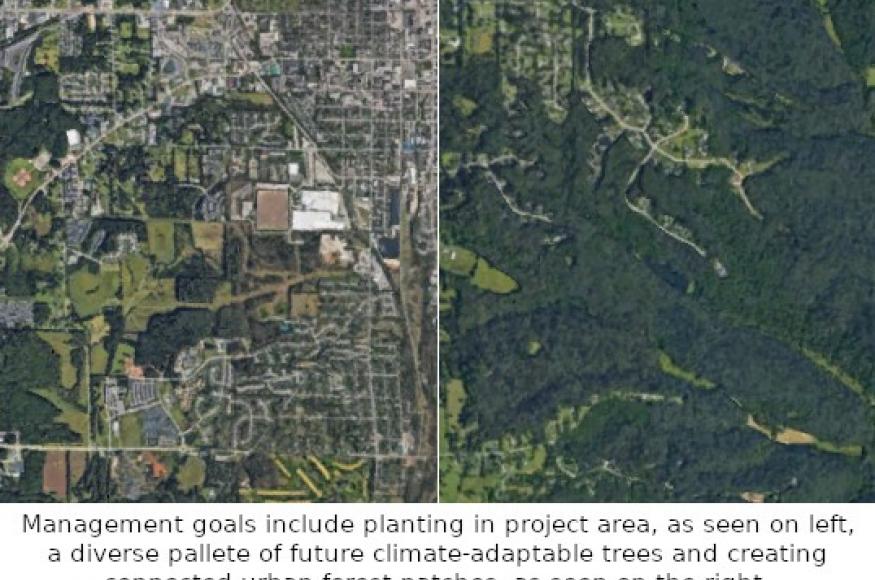
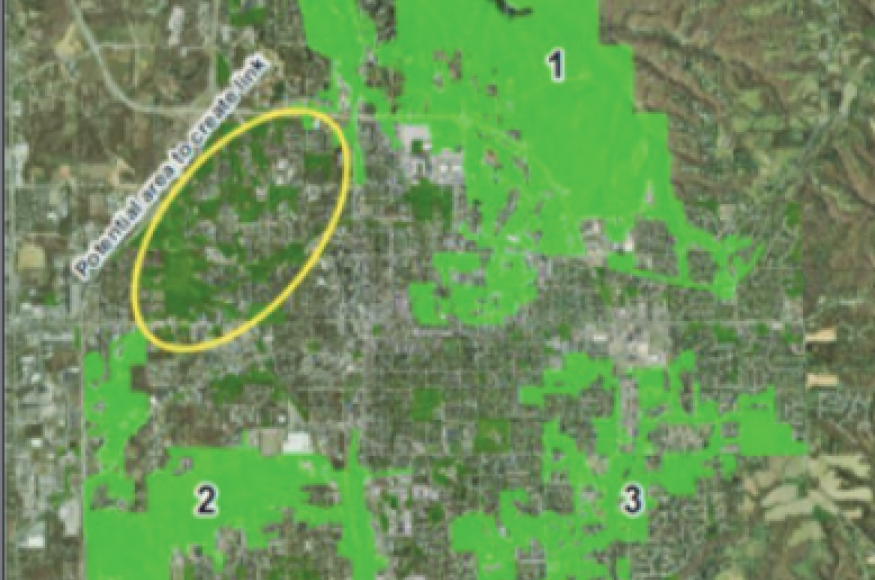
 The project area is largely on the west side of Bloomington, where the Griffy Lake watershed to the north of the city meets the Clear Creek watershed to the south. The planting area includes municipal, residential, and commercial areas, all of which would be considered part of Blomington’s Urban Forest.
Management Goals


- Assess existing canopy cover and species composition of existing forest patches using a combination of Bloomington’s 2019 street tree inventory and i-Tree software.
- Work with Bloomington’s Urban Forester to create and maintain a list of trees expected to thrive in both current and future climate conditions to be planted in the project site .
- Identify areas where intensive planting could increase overall tree canopy and connect or enlarge existing patches.
Challenges and Opportunities
Climate change will present challenges and opportunities for accomplishing the management objectives of this project, including:
Challenges
Existing tree canopy density may be impacted by tree mortality due to climate change impacts such as strong storms
Droughts in summer may require additional irrigation of younger and more sensitive trees
Unstable temperature patterns in the early spring may interfere with tree budding and fruit production
Opportunities
There are tree species expected to do well in future climate conditions that can be planted now to ensure a more resilient urban forest in the future
As public awareness grows regarding climate change, the urban forest may be considered as a greater priority in adaptation to climate impacts
Bloomington’s new street tree inventory will be easier to update and analyze, including tree conditions, which can inform future management decisions
Adaptation Actions
Project participants used the Adaptation Workbook to develop several adaptation actions for this project, including:
Area/Topic
Approach
Tactics
Whole site
Ensure new plantings of planned corridor are diverse as to family/genus/species. Plant disease-resistant species.
Whole site
Plant in areas along corridor connecting Lake Griffey and Clear Creek watershed to create a series of connected forest patches.
Whole site
Determine a percentage of plantings that will be native species. Include species that are at present in the northenmost area of their range to address warming temperatures expected by mid-century.
Whole site
Include regional midwest natives (especially southern midwest natives that are more typically grown in the most southern areas of Indiana and northern Kentucky in plantings.
Monitoring
Project participants identified several monitoring items that could help inform future management, including:
Survival rate after three years of trees planted in project area, include specific data on species
Changes in canopy cover density in project area
Changes in family/genus/species diversity and tree age structure diversity
Learn More
Keywords
Urban